

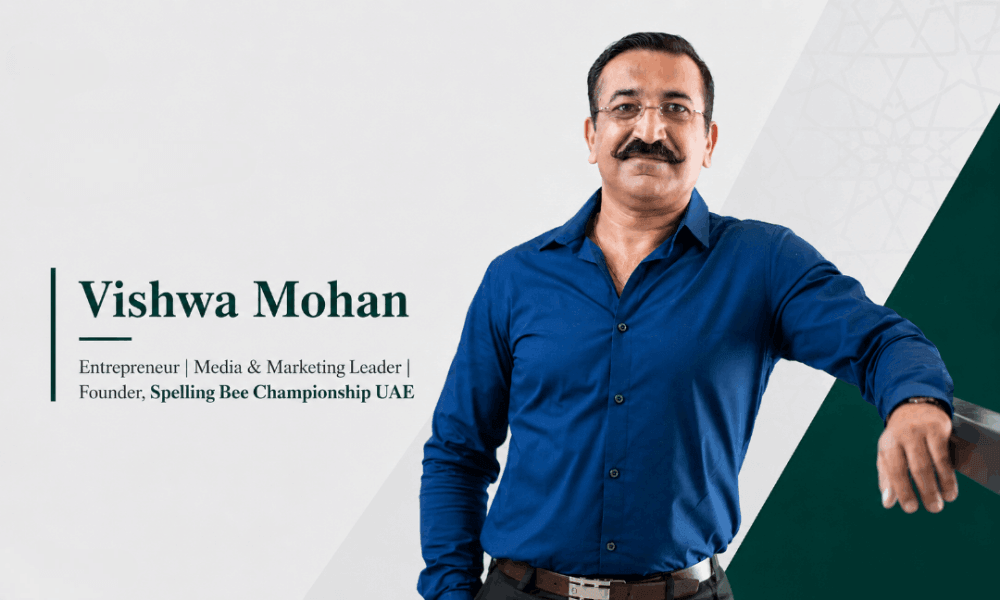
With more than 34 years of professional experience across the Middle East and Africa, Vishwa Mohan has built a distinctive leadership journey spanning insurance, events, traditional media, digital media and entrepreneurship. From beginning his career as an insurance salesperson to taking on leadership roles involving radio stations, television networks and innovative media solutions, his career reflects an ability to adapt, identify opportunities and create value across changing industries.
Today, Vishwa is extending that experience into entrepreneurship across sustainability, data analytics, programmatic campaigns and education. Through initiatives such as OnlyGood, he is contributing to sustainability and carbon-footprint reduction, while his work with Icogz focuses on helping businesses use data-driven insights for strategic decision-making. His involvement with the Spelling Bee Championship, with support from the Scripps National Spelling Bee, further reflects his commitment to creating meaningful educational opportunities for students across the Middle East.
What distinguishes Vishwa’s journey is not simply the breadth of industries he has worked across, but the values that have remained consistent throughout them: empathy, gratitude, innovation and delivering genuine value to customers and communities.
Arabian Leaders Views is featuring Vishwa Mohan among “The 5 Arabian Visionary Business Leaders to Watch in 2026” because his journey represents the evolving nature of leadership in the region; where experience, entrepreneurship, technology, sustainability and education increasingly intersect to create meaningful impact.
Success is rarely built in one defining moment. More often, it is built through thousands of ordinary moments that nobody notices. For a business leader who has spent more than three decades building a career and life in Dubai, this understanding has become more than a philosophy; it has become a way of living. When he first arrived in Dubai, he carried the same things that many expatriates bring with them: hope, ambition, uncertainty and a quiet promise to himself that one day he would build something meaningful. He was not looking for comfort. He was looking for possibility. Over the years, Dubai taught him that dreams are easy because everyone dreams. What the city truly rewards, he believes, is something much harder: belief. Belief is what gets a person out of bed when nobody knows their name. It is what encourages an entrepreneur to send another proposal after ten rejections, start again after losing something they believed they had built, and walk into a room where nobody expects them to succeed while still behaving as though success is possible. Dreams happen while people sleep; belief keeps them awake. That distinction has quietly shaped his professional journey.
A Career Built Around People, Not Industries
His career has moved across insurance, exhibitions, radio, television, events, media, digital transformation and education. On paper, these may appear to be completely different industries, but he does not see them that way. For him, the common thread has always been people. The product changed, the audience changed and technology changed, but people remained remarkably consistent in what they wanted. Whether someone is purchasing an insurance policy, listening to a radio programme, launching a brand, attending an event or registering a child for an educational competition, people are ultimately looking for confidence. They want confidence that they are making the right decision, confidence that someone understands them and confidence that tomorrow can be better than today. This understanding has influenced the way he approaches business, communication and leadership. The older he becomes, the more convinced he is that business has very little to do with products and everything to do with people. People may forget what they were sold, but they rarely forget how they were made to feel.
The Belief That Drives His Work
For Vishwa Mohan, leadership has always been about more than professional achievement. It is about creating meaningful outcomes, giving people the confidence to discover their potential, and building initiatives that leave a lasting impact. This belief is reflected strongly in his work with the Spelling Bee Championship UAE, where education becomes a platform for developing confidence, curiosity and courage among young people. Across his work in entrepreneurship, education, media and leadership, the underlying purpose remains consistent: to create opportunities that help people and communities move forward.
From Chasing Success to Creating Significance
Earlier in his career, success had a much simpler definition. A bigger client, a larger campaign, higher revenue, another promotion, another title and another achievement represented progress. Like many ambitious professionals, he believed success was something that could be collected. Over time, however, life began teaching him different lessons. Some came through victories, while others arrived through disappointments, unexpected opportunities and encounters with people who changed his perspective. Eventually, he came to an uncomfortable realization: success is a terrible destination. The moment one milestone is reached, another appears. The promotion becomes normal, the revenue target increases, the business grows and expectations become bigger. The mountain never seems to end. That realization changed the question he asked himself. Instead of asking, “What did I achieve?” he began asking, “Whose life became better because I was there?” The difference between those two questions is significant. Success measures achievement, while significance measures impact. For him, the second question has become far more important.
Why the Spelling Bee Is Really About Confidence
This philosophy is particularly visible through his involvement with the Spelling Bee Championship UAE. Many people may see a spelling competition as an educational event focused on words and competition. He sees something much bigger. In his view, spelling is simply the vehicle; the real destination is confidence, curiosity, discipline and courage. A child standing on a stage under bright lights, hearing an unfamiliar word, asking for its definition and then attempting to spell it while hundreds of people are watching is experiencing a lesson that extends far beyond spelling. Life eventually asks adults to do exactly the same thing. We are all placed in situations where we have to listen carefully, think calmly, make decisions and act despite uncertainty. That is why one of the most meaningful outcomes for him is not necessarily seeing a child win a trophy. It is seeing a nervous child walk onto a stage and leave believing, “I can do this.” That transformation represents the real victory.
Turning Fear Into a Lesson in Courage
One interaction with a young participant illustrates this philosophy particularly well. Before going on stage, the child was visibly nervous and asked what would happen if he forgot everything. Instead of giving him a complicated explanation, he was reminded of a simple interpretation of fear: “False Evidence Appearing Real.” The feeling of fear can be real, but the evidence behind that fear often is not. An entrepreneur may imagine losing a business before it happens. A speaker may imagine embarrassing themselves before stepping onto a stage. A parent may imagine failure before a child has even begun. Human beings often allow their imagination to create evidence that reality has never produced. That lesson, initially shared with a child before a spelling competition, became a broader reflection on life and leadership. Courage is not the absence of fear. Courage is the decision to move forward despite it.
When Resilience Refuses to Become an Excuse
Some of the most powerful lessons from the Spelling Bee Championship UAE have come from participants whose circumstances could easily have become obstacles. A young girl arrived in a wheelchair and simply wanted to compete like everyone else. Another student arrived with his arm in a cast, making writing difficult. Rather than removing the students from the competition, the team focused on removing the obstacles. Support was arranged so they could participate fairly and confidently. Neither child asked for sympathy. They wanted an opportunity. Those experiences reinforced a belief that inclusive leadership is not simply about policies written inside handbooks or statements published on corporate websites. Sometimes inclusion is a decision made in a single moment: a decision to remove an obstacle without removing the opportunity. Watching those children continue despite their circumstances demonstrated something he believes every leader should understand. Resilience rarely makes noise. It simply turns up.
The Experience That Showed the Power of Inspiration
Another memorable lesson came through a message from a mother after one of the competitions. Her daughter, Noora, had returned home with small gifts from the event and given them to her younger sister. She then told her sister that when she was old enough, she should also participate in the Spelling Bee and learn her spellings well. The mother, who was on bed rest, described how deeply the moment affected her. For him, the story was meaningful not because the child had won, but because she had become an ambassador for learning without anyone asking her to. Children do not always inspire through speeches or formal leadership programmes. Sometimes they inspire simply through excitement and example. When one child’s experience motivates another child to dream about participating in the future, something much larger than a competition has taken place.
“My Ball Is My Ball”: A Lesson in Leadership
His approach to leadership has also been shaped by experiences outside business and education. One of his most memorable metaphors comes from golf. Like any beginner, he received plenty of advice about posture, grip, backswing and technique. Yet one morning, while standing over the ball, he realized something simple: regardless of how experienced the coach was or how expensive the equipment might be, nobody else could hit his ball. The shot was his. Years later, that observation became a leadership principle. In business, people often spend too much time searching for someone else to blame when things go wrong. They blame the economy, the market, competitors, technology or circumstances. But leadership begins when excuses end. When a project fails, the more important question is not always “Who is responsible?” Sometimes the better question is, “Was it my ball?” If the answer is yes, responsibility also belongs to the person holding the club. Accepting ownership does not guarantee that every decision will succeed, but it creates the mindset required to learn, adapt and improve.
The Lift That Taught Him About Patience
Another ordinary experience offered a completely different lesson. One afternoon, while waiting for a lift, he noticed people repeatedly pressing the already illuminated button. The lift was coming, but they continued pressing as if additional effort might somehow make it arrive faster. The situation reminded him of something he had often done in business: sending another reminder, refreshing a dashboard, checking numbers repeatedly, refreshing an inbox or making another call simply to feel that something was happening. Sometimes people confuse activity with progress. The lift does not arrive faster because the button is pressed harder. A seed does not grow because someone repeatedly digs it up to check its roots. Some situations require action, while others require patience. One of the most valuable leadership skills is knowing which situation one is facing.
Why Leaders Must Be Willing to Learn From the Next Generation
His understanding of leadership has also evolved through his relationship with the next generation. During a conversation with his son about a business idea, he confidently explained why something was being done in a particular way. His son listened and then asked a simple question: “Why are you doing it that way?” The immediate answer was, “Because that is how it has always been done.” The conversation eventually revealed a different approach. The experience became a lesson in reverse mentoring. Experience helps people recognize patterns, but youth has the freedom to question them. In a rapidly changing business environment, neither perspective is complete without the other. Strong leaders do not simply teach. They remain curious enough to learn. They understand that leadership does not mean having every answer; sometimes it means being willing to listen when someone younger sees a possibility that experience has made difficult to notice.
What Dubai Taught Him About the Arabian Business Landscape
Dubai and the wider Arabian business environment have played an important role in shaping this perspective. His journey across media, marketing, entrepreneurship and education has reinforced his belief that relationships create opportunities long before presentations do. Trust often travels faster than advertising. Businesses may invest heavily in campaigns, websites and promotional strategies, but long-term relationships are built through consistency, reliability and the ability to honour commitments. The growth of the Spelling Bee Championship UAE demonstrates this principle. Schools do not participate simply because a brochure exists. Parents do not register their children simply because a website exists. They participate because trust has been established. In a region where relationships remain central to business and professional development, this human element continues to be one of the most powerful forms of competitive advantage.
Redefining Success Through Purpose
As his career has matured, his definition of legacy has also changed. Earlier, the focus may have been on companies, revenue, achievements, campaigns and awards. Today, the more meaningful question is what remains in people after the business activity is over. If someone asks what he hopes to have built twenty years from now, he does not want to begin with companies. He wants to begin with people. Perhaps it will be a young entrepreneur who found confidence because of one conversation. Perhaps it will be a teacher who encouraged another generation. Perhaps it will be a child who discovered courage by standing on a stage and attempting a difficult word. Perhaps it will be a parent who learned to replace pressure with encouragement. Buildings age, businesses evolve and campaigns eventually end, but confidence can travel from one generation to another.
Recognition Belongs to More Than One Person
This perspective also changes how recognition is viewed. Receiving an Excellence in Student Engagement Award may appear to be an individual accomplishment, but he sees the recognition differently. The award belongs to the children who found the courage to step onto the stage, the parents who encouraged them, the teachers who supported them and the volunteers who made the experience possible. His name may be engraved on the trophy, but the story belongs to thousands of others. That is perhaps one of the most important characteristics of meaningful leadership: understanding that recognition may arrive in one person’s hands, but its roots are always found in many people’s efforts.
Beyond Titles, Companies and Professional Identity
For many years, he introduced himself through what he did. He worked in media, ran businesses, organized events and built initiatives. Over time, however, he came to understand that professional identities are fragile. Titles change, companies evolve and business cards are replaced. If identity depends entirely on what someone does, every career transition can become an identity crisis. Today, he prefers to remember something simpler: before being entrepreneurs, executives, organizers or business leaders, people are human beings. And human beings are ultimately remembered more for their character than their designation.
The Future of Visionary Leadership in Arabia
That philosophy has brought him to a different understanding of purpose. Revenue matters because businesses must survive. Strategy matters because organizations must grow. Innovation matters because markets constantly evolve. But purpose determines whether the journey is worth pursuing. His own purpose has become remarkably consistent despite the many industries and platforms through which he has worked. He wants to build confidence. Sometimes that happens through business. Sometimes through media. Sometimes through education. The platform changes, but the purpose remains.
His story offers an interesting perspective on what visionary leadership can mean in the Arabian business landscape of 2026. Vision does not always have to mean building the biggest company or pursuing the most ambitious financial target. Sometimes it means recognizing a human problem and creating something that helps people overcome it. Sometimes it means giving a child the confidence to stand on a stage. Sometimes it means accepting responsibility when the ball is yours. Sometimes it means knowing when to stop pressing the lift button and simply allow the journey to unfold.
Building a Legacy That Lives Through People
Ultimately, the most powerful image from his journey may be a child standing on a stage, hearing an unfamiliar word, taking a deep breath and asking, “May I have the definition, please?” On the surface, it is a question about spelling. At a deeper level, it is a question about courage. It represents the willingness to stand in front of uncertainty and take the next step anyway.
That may also be the most enduring lesson from his career. Leadership is not about being fearless. It is about moving forward despite fear. It is not simply about creating organizations; it is about creating confidence in people. It is not only about achieving success; it is about creating significance.
After more than three decades in Dubai and a career that has crossed industries, platforms and generations, his philosophy can be reduced to one simple idea: people rarely need someone to tell them what they are capable of. Sometimes they simply need someone to believe in them long enough for them to discover it themselves.
And perhaps that is the legacy worth building not a legacy of followers, but a generation of people who eventually learn to believe in themselves.