

Building a Stronger Future for Islamic Banking
The Islamic finance industry continues to experience significant growth globally, driven by increasing demand for ethical, responsible, and Shari’a-compliant financial solutions. At the heart of this transformation are leaders who combine financial expertise, strategic vision, and a deep commitment to creating value for customers, employees, shareholders, and society.
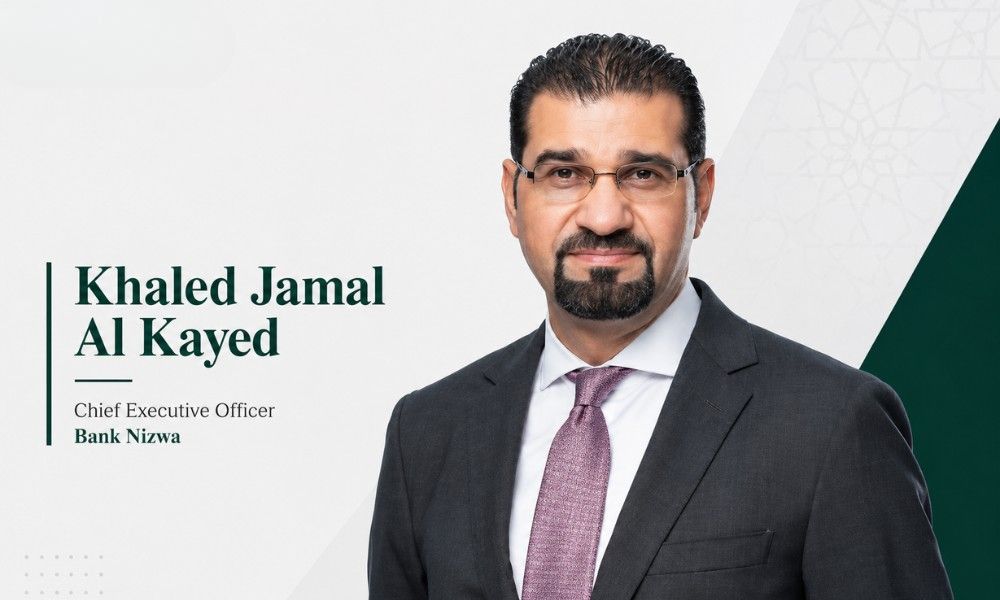
For Khaled Jamal Al Kayed, Chief Executive Officer of Bank Nizwa, leadership is not only about achieving business growth but also about contributing positively to the wider Islamic finance ecosystem. His journey reflects a commitment to continuous improvement, innovation, and building an institution that creates meaningful value for all stakeholders.
“Every day, we are trying to lead, learn, benchmark, and bring something new to be added to the institution. To lead by example, one must keep learning and add value daily,” Khaled believes.
With a strong background in banking, international accounting, and finance, Khaled has played a key role in strengthening Bank Nizwa’s position as one of the leading Islamic banking institutions in Oman.
Bank Nizwa: Establishing a New Era of Islamic Banking in Oman
Bank Nizwa is Oman’s first dedicated Islamic bank, offering fully Shari’a-compliant products and services designed to meet the evolving financial needs of individuals, businesses, and institutions. Since opening its doors in 2013, the bank has played a significant role in developing the Islamic finance sector in Oman.
Khaled Jamal Al Kayed has been closely involved with the bank’s leadership journey for nearly a decade, working with management teams and boards to guide the institution through three important phases: startup, growth, and establishing itself as a strong and sustainable bank.
When Bank Nizwa began operations in 2013, it started with a capital base of OMR 150 million. Over the years, through strategic expansion, customer trust, and operational excellence, the bank has grown significantly, reaching a total balance sheet value of approximately OMR 1.5 billion.
This growth represents more than financial success. It reflects Bank Nizwa’s contribution to Oman’s economy, society, and Islamic finance industry. By continuously developing new services, improving customer experiences, and identifying emerging market needs, the bank has strengthened relationships with clients and positioned itself as a trusted financial partner.
Today, Bank Nizwa is recognized not only within the GCC region but also internationally within the Islamic finance community. The institution continues to focus on meeting stakeholder expectations while maintaining its commitment to responsible banking and sustainable growth.
Leadership Through Values, Communication, and Inclusion
For Khaled, effective leadership begins with understanding the responsibility that comes with managing an Islamic financial institution. A balanced approach is essential to ensure that the objectives of shareholders, customers, regulators, employees, and society are all considered.
His leadership philosophy is built around simplicity, transparency, and communication. He believes that successful organizations do not need unnecessary complexity; instead, they require clear direction, strong engagement, and a shared understanding of goals.
“At Bank Nizwa, we believe in leadership through communication because keeping people informed creates stronger engagement, better feedback, and improved decision-making,” Khaled explains.
By encouraging open discussions and involving employees in the journey of continuous improvement, Bank Nizwa has developed a culture where innovation and collaboration can thrive.
Creating a Culture of Continuous Learning and Growth
Khaled believes that successful leaders must be strong listeners and effective communicators. A leader’s role is not only to define a vision but also to ensure that teams understand the purpose behind every strategy and decision.
His approach focuses on building a positive organizational culture where people are encouraged to learn, contribute, and grow. By regularly reviewing the institution’s progress and measuring its contribution to the industry, Khaled ensures that Bank Nizwa continues moving forward despite challenges.
For him, leadership is a continuous journey of learning, adapting, and creating impact. The ability to look back at achievements while planning future improvements allows organizations to remain competitive and resilient.
Driving Digital Transformation in Islamic Banking
Technology has become a defining factor in the future of financial services, and Bank Nizwa continues to invest in digital transformation to enhance customer experiences and operational efficiency.
Under Khaled’s leadership, the bank has undertaken major technology initiatives, including infrastructure modernization, network and server improvements, cybersecurity enhancements, and core banking system upgrades. These developments have created a stronger foundation for adopting emerging technologies and delivering advanced banking solutions.
The institution has also expanded its digital platforms to support multiple channels, including retail banking, transactional banking, and corporate trade finance. These initiatives are designed to provide customers with greater convenience, accessibility, and personalized financial services.
Looking ahead, Bank Nizwa aims to further expand its distribution network, increasing its branch presence from 17 branches to more than 20 while also developing fully digital banking solutions with the support of the Central Bank of Oman.
The bank is also actively engaging with FinTech companies to explore new opportunities and accelerate innovation within Islamic finance.
Supporting Oman Vision 2040 Through Islamic Finance
Bank Nizwa’s long-term vision aligns with Oman’s broader economic development goals, particularly Oman Vision 2040. The institution aims to contribute not only through Islamic banking but also through the wider Islamic finance sector.
The bank’s strategic priorities include maintaining strong asset quality, effective liquidity management, sustainable profitability, and continuous innovation.
By combining technology, financial expertise, and Shari’a-compliant principles, Bank Nizwa is working toward creating a stronger financial ecosystem that supports individuals, businesses, and the national economy.
A Visionary Leader Shaping Islamic Finance
Khaled Jamal Al Kayed is an experienced banking leader with a Master’s degree in International Accounting and Finance and extensive expertise in financial services. His leadership is built on integrity, relationship-building, and a commitment to creating long-term value.
Recognized for his contribution to the Islamic banking sector, Khaled has received recognition as the Best CEO – Islamic Bank, Oman. His achievements reflect his dedication to excellence and his role in strengthening Bank Nizwa’s position within the industry.
Beyond his professional journey, Khaled values continuous learning and personal growth. His favorite book, Give and Take by Adam Grant, reflects his belief in generosity, collaboration, and creating value through meaningful relationships.
Shaping the Next Chapter of Islamic Finance
The future of Islamic finance will be shaped by institutions that combine innovation with purpose. Through strategic leadership, digital transformation, and stakeholder-focused growth, Bank Nizwa continues to demonstrate how Islamic banking can evolve while staying connected to its core values.
Khaled Jamal Al Kayed’s journey represents the impact of visionary leadership in building institutions that are not only financially strong but also socially responsible and prepared for the future.
Editorial Note:
This article has been prepared based on publicly available online sources, references, and information accessible at the time of writing. The content is created for editorial and informational purposes only and does not represent an official statement, endorsement, or direct communication from the individual or organization mentioned. All information has been presented with the intention of highlighting leadership journey, industry contributions, and professional achievements based on available references.