

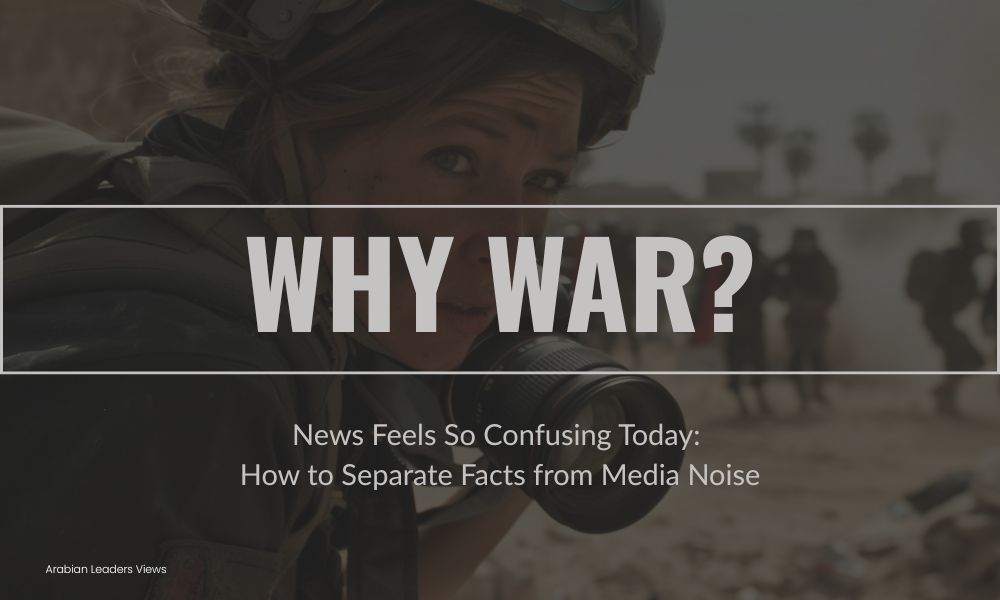
Have you ever opened your phone during a major conflict and wondered why every news outlet seems to report something completely different? One headline says a country is winning, another says it is losing, while social media is flooded with dramatic videos, emotional posts and breaking updates every few minutes. It can leave anyone feeling confused.
If you’ve experienced this, you’re certainly not alone.
Modern wars are no longer fought simply on battlefields. They are also combated through television broadcasts, internet news websites, social media platforms, videos, AI-generated content and popular opinion. Information moves quicker than ever before, yet speed does not always equal accuracy. In fact, the faster news spreads, the more likely rumors, misinformation and inaccurate reports will surface before the truth is revealed.
Everyone now needs to be able to understand how combat news operates. Rather than trusting the first headline that pops up on your computer, it’s worth pausing to consider this crucial question: Is this information validated, or is it just another piece of the never-ending online clutter?
The First Report Is Rarely the Complete Story
During an active conflict, journalists often work with limited information. Communication networks may be disrupted, officials may release only partial statements and eyewitness accounts can differ significantly from one another. As a result, the first version of a breaking story frequently changes over the following hours or days. What initially appears to be confirmed news may later be corrected as additional evidence becomes available.
This does not necessarily mean that the media is intentionally misleading people. It often reflects the reality that gathering accurate information during wartime is extremely challenging. Responsible readers understand that early reports should be viewed as developing stories rather than final conclusions.
Social Media Can Spread Truth and Misinformation
Platforms such as X, Facebook, Instagram, TikTok and YouTube have transformed how people consume war news. A video recorded on a smartphone can reach millions within minutes. However, popularity should never be confused with credibility. Some videos are taken from entirely different countries or from conflicts that happened years ago. Others are edited to remove important context, making viewers believe something completely different from what actually occurred.
Advances in artificial intelligence have also made manipulated images, cloned voices and realistic fake videos much harder to identify. Before sharing dramatic content, it is always wise to verify whether multiple trusted news organizations have confirmed the same event.
Like Every Book, Every Source Has a Perspective
One of the biggest reasons war coverage appears inconsistent is that different organizations often present the same event from different perspectives. Government officials may emphasize victories to maintain public confidence. Military spokespersons may withhold operational details for security reasons. International media may focus on humanitarian concerns, while local media may highlight national interests.
This does not automatically make any single source entirely right or entirely wrong. It simply reminds us that every report reflects the information available and the perspective through which it is presented. Reading reports from multiple reputable sources helps create a more balanced understanding of complex events.
Emotional Headlines Are Designed to Capture Attention Words like “shocking,” “devastating,” “breaking,” or “unbelievable” immediately attract attention. In today’s highly competitive digital environment, headlines are often written to encourage clicks and engagement.
does not mean the underlying information is false. but, emotional headlines sometimes exaggerate uncertainty or oversimplify complicated situations. A thoughtful reader looks beyond the headline and examines the complete article before forming an opinion.
Verification Matters More Than Speed
Many people feel pressure to share breaking news instantly with friends and family. Unfortunately, this can unintentionally spread false information if the original report turns out to be inaccurate. A simple habit can make a significant difference: pause before sharing. Ask yourself a few basic questions. Has the information been confirmed by several reliable news organizations? Does the article identify credible sources?
Are there official statements supporting the claim? If the answer is unclear, waiting a little longer is often the smartest decision.
Critical Thinking Is Everyone’s Responsibility
The digital age has given us unlimited access to information, but it has also placed greater responsibility on readers. Instead of accepting every viral post as fact, we should develop the habit of questioning what we see. Healthy skepticism is not about rejecting all news. It is about evaluating evidence carefully, recognizing uncertainty and understanding that facts sometimes emerge gradually rather than instantly.
In times of conflict, responsible information sharing becomes just as important as responsible journalism.
War is one of the most complex subjects any journalist can cover. Facts evolve rapidly, official statements change, eyewitness accounts differ and social media often amplifies both truth and misinformation at the same time.
Thank you for reading. If you found this article helpful, subscribe to stay updated with more insightful articles that help you understand today's world with clarity, accuracy and confidence.