

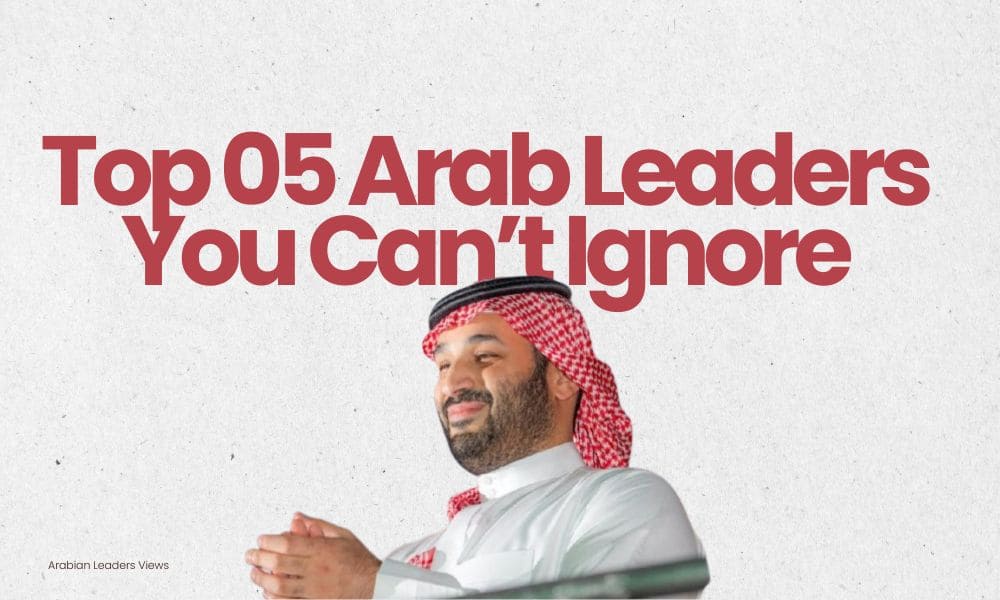
The Arab world has long played an important role in shaping global politics. With its strategic location, economic dominance, oil resources, cultural significance, and expanding diplomatic links, the region continues to influence decisions far beyond the Middle East.
Today, Arab leaders are not only influencing regional policies but also contributing to global discussions on security, trade, technology, energy, investment and international cooperation. From economic transformation plans to diplomatic initiatives, these leaders are creating a new chapter for the Arab world on the global stage.
Arabian Leaders Views Magazine, Explore the Top 05 Arab leaders you can’t ignore in world politics and understand how their leadership is shaping the future of their nations and influencing global conversations.
Mohammed bin Salman (Saudi Arabia)
Mohammed bin Salman has become one of the most recognized Arab leaders in global politics. As the Crown Prince and Prime Minister of Saudi Arabia, he has introduced a bold vision to transform the Kingdom’s economy and international position.
Through Saudi Vision 2030, Mohammed bin Salman is working to reduce Saudi Arabia’s dependence on oil by expanding industries such as technology, tourism, entertainment, renewable energy, and infrastructure. This ambitious plan has attracted billions of dollars in global investment and positioned Saudi Arabia as a key economic player.
His leadership has also increased Saudi Arabia’s influence in international diplomacy. The Kingdom has become an important partner for major global economies, playing a significant role in discussions related to energy markets, regional stability, and international investment.
Beyond economics, Mohammed bin Salman’s initiatives have changed Saudi society, including expanding opportunities for women, developing tourism projects, and modernizing various sectors.
His decisions continue to influence global markets and international relations, making him one of the most important Arab figures in today’s world politics.
Mohammed bin Zayed Al Nahyan (United Arab Emirates)
Mohammed bin Zayed Al Nahyan, widely known as MBZ, is considered one of the most influential leaders in the Arab world.
As the President of the United Arab Emirates, he has played a major role in transforming the UAE into a global center for business, technology, innovation, and diplomacy.
Under his leadership, the UAE has strengthened its position as an international hub connecting Asia, Europe, Africa, and the Middle East. Dubai and Abu Dhabi have become major destinations for investors, entrepreneurs, and multinational companies. UAE’s focus on artificial intelligence, renewable energy, space exploration, financial services and advanced technology reflects a long-term strategy to prepare for the future.
Mohammed bin Zayed has also focused on expanding diplomatic relationships with countries worldwide. The UAE has become increasingly active in global discussions related to economic partnerships, climate change, humanitarian efforts, and regional security. His leadership style combines economic development with international diplomacy, making the UAE one of the most influential Arab nations in global affairs.
Abdel Fattah el-Sisi (Egypt)
Abdel Fattah el-Sisi remains one of the most significant political figures in the Arab world due to Egypt’s historical, geographic, and strategic importance. As the President of Egypt, el-Sisi leads the most populous Arab country and one of the most strategically located nations in the world. Egypt controls the Suez Canal, one of the most important waterways for global trade, connecting the Mediterranean Sea with the Red Sea.
Egypt’s role in international politics extends across security, diplomacy, and economic cooperation. The country has historically played a major role in Middle Eastern peace discussions and continues to be an important voice in regional matters. Under his leadership, Egypt has invested heavily in infrastructure development, energy projects, transportation networks, and urban expansion. Large-scale projects aim to strengthen the country’s economy and improve its global competitiveness.
Egypt’s influence comes not only from its size but also from its diplomatic importance. The country remains a central player in discussions involving the Middle East, Africa, and international organizations.a
Tamim bin Hamad Al Thani (Qatar)
Tamim bin Hamad Al Thani has established Qatar as an important player in global politics through strategic diplomacy and economic strength. As the Emir of Qatar, Sheikh Tamim has focused on strengthening the nation’s position as a major global energy supplier and diplomatic partner.
Qatar’s natural gas resources have made it one of the world’s most important energy exporters. The country’s influence in global energy markets has increased significantly, especially as nations seek reliable energy partnerships. Beyond energy, Qatar has developed a reputation for international mediation and diplomatic engagement. The country has participated in discussions involving regional conflicts, humanitarian issues, and international negotiations.
Qatar has also invested heavily in education, sports, technology, and infrastructure. Hosting major international events has helped increase its global visibility and strengthen its role as a modern Arab nation. Through economic power and diplomatic efforts, Sheikh Tamim continues to position Qatar as a country with influence far beyond its size.
King Abdullah II (Jordan)
Abdullah II of Jordan is one of the longest-serving Arab leaders and an important figure in Middle Eastern diplomacy. As the King of Jordan, Abdullah II has consistently promoted regional stability, international cooperation, and peaceful solutions to complex challenges.
Jordan holds a unique position in the Middle East because of its diplomatic relationships and strategic location. The country has played an important role in discussions related to regional security, humanitarian issues, and peace initiatives. King Abdullah II has also focused on economic development, education, technology, and modernization. Despite facing economic challenges and regional pressures, Jordan continues to maintain strong relationships with countries around the world.
His international reputation as a moderate and diplomatic leader has helped Jordan remain an important partner for global organizations and foreign governments. In a region where political challenges are constantly changing, King Abdullah II continues to represent stability and dialogue.
Growing Influence of Arab Leaders in Global Politics
The influence of Arab leaders is expanding beyond traditional areas such as energy and regional security. Today, Arab nations are investing in technology, artificial intelligence, renewable energy, tourism, innovation and global partnerships. Countries across the Arab world are becoming important contributors to international discussions about the future economy, climate change, digital transformation, and global cooperation.
The leadership strategies of these figures show a shift from traditional political influence toward a broader approach based on economic development, innovation, and international partnerships. As global challenges continue to evolve, the role of Arab leaders will remain significant in shaping future international decisions.
Arab Leadership Shaping the Future of World
The Arab world continues to produce leaders who influence not only their own nations but also global conversations. From economic transformation and energy leadership to diplomacy and international cooperation, these figures are shaping the direction of world politics. Top 05 Arab leaders you can’t ignore in world politics represent different leadership styles, but they share one common goal: strengthening their countries’ positions in an increasingly connected world.
Stay connected with Arabian Leaders Views to discover inspiring stories, leadership insights and profiles of influential personalities shaping the future of our world.